
supercritical CO2 extraction
above a certain temperature and pressure, CO2 behaves neither fully as a gas nor as a liquid: it dissolves like a liquid and spreads like a gas. all our products are obtained with CO2 in this state, separated from the plant material; the extraction agent is natural carbon dioxide.
- document
- pc·t·02
- revision
- 2026.10
- status
- preview
01principle
the critical point is a threshold, not a setting.
the critical point of CO2 is about 31 °C and 73.8 bar. the supercritical region lies above both values. these figures are a physical property of the substance; the facility's operating pressure and temperature are chosen separately above that threshold, for the target compound and the raw material.
as pressure and temperature change, so does the density of CO2; as density changes, so do the compounds it can dissolve. this is why different settings can yield extracts of different profiles from the same plant. when pressure drops in the separator, CO2 turns back into gas, the extract separates and the CO2 is recovered into the loop.
02facility
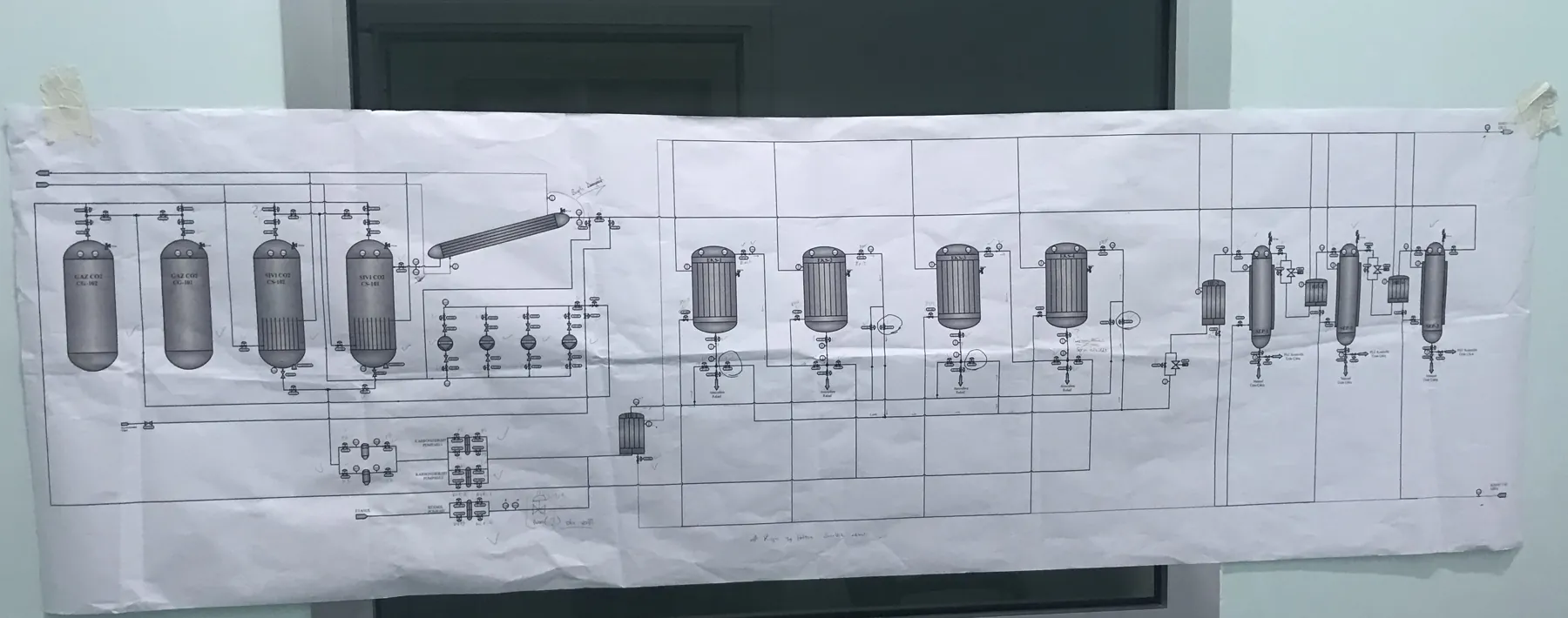
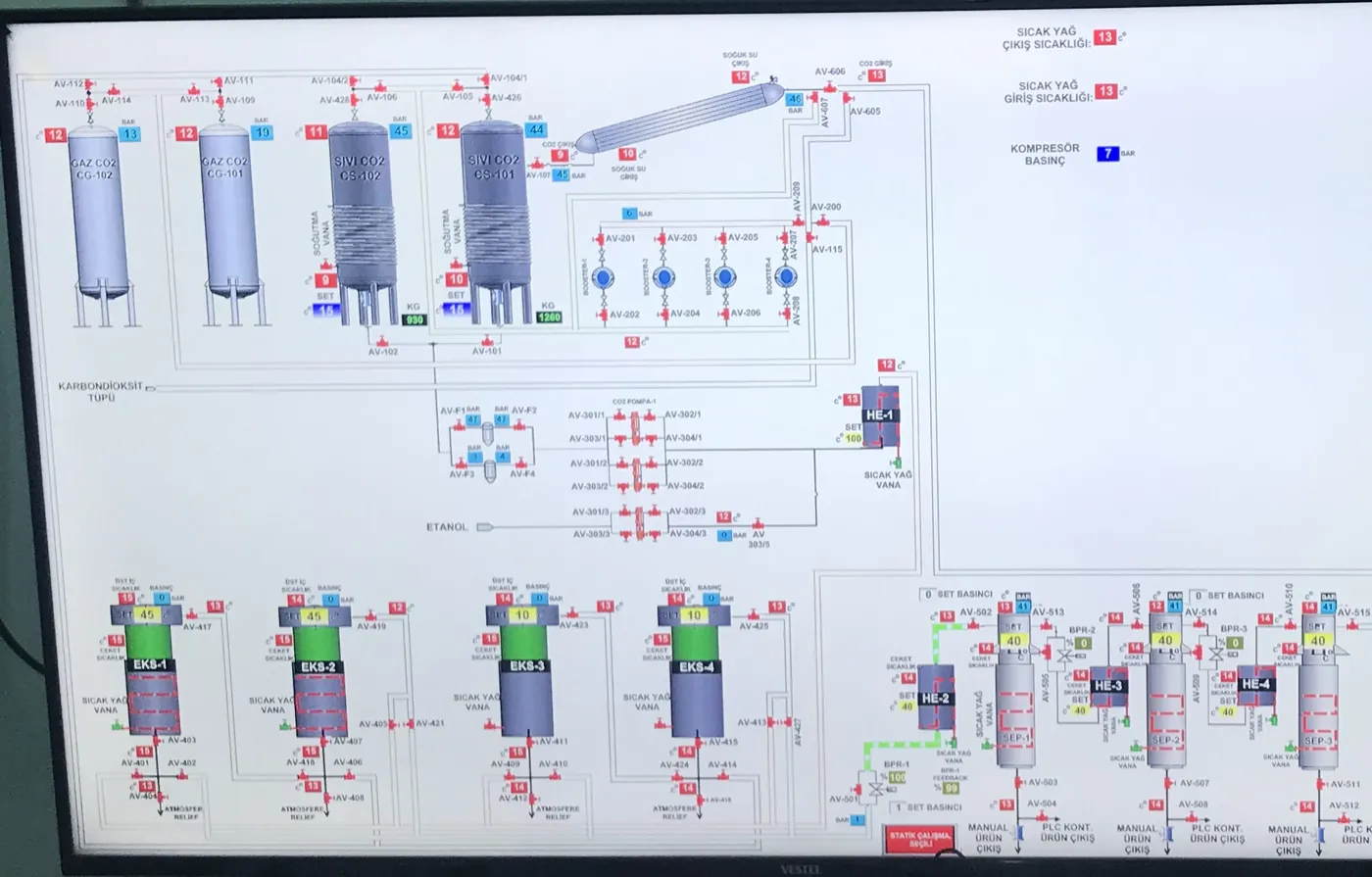
the diagram on paper, the line on screen.
03settings
six variables that shape the result.
- pressure
- sets the density and dissolving power of CO2.
- temperature
- affects density and volatility together; sets limits for heat-sensitive compounds. the system's maximum operating temperature is +80 °C.
- CO2 flow and time
- determine yield and process time.
- raw material preparation
- particle size and moisture change how the agent reaches the material.
- co-solvent
- for polar compounds a small amount of ethanol may be added to CO2; the system has a separate line for it. no co-solvent is used in our current products. brand statement
- separation conditions
- how pressure is released across the three separator stages determines which fractions of the extract are collected.
04system
four scales from r&d to production.
| model | extractor | separators | CO2 flow | heating | chiller | co-solvent pump |
|---|---|---|---|---|---|---|
| 5 lt · r&d | 5 lt × 1 · 500 bar | 2.5 lt × 3 · 500–350–250 bar | 1 lt/min | 5 kw | 5,000 kcal/h | 5 kg/h · 500 bar |
| 50 lt · production | 25 lt × 2 · 400 bar | 15 lt × 3 · 400–250–150 bar | 5 lt/min | 20 kw | 20,000 kcal/h | 25 kg/h |
| 100 lt · production | 50 lt × 2 · 400 bar | 25 lt × 3 · 400–250–150 bar | 10 lt/min | 40 kw | 40,000 kcal/h | 50 kg/h |
| 500 lt · production | 250 lt × 2 · 400 bar | 150 lt × 3 · 400–250–150 bar | 50 lt/min | 100 kw | 100,000 kcal/h | 100 kg/h |
- material
- super duplex stainless steel (1.4410 / 1.4417) or ss316
- heating
- electric resistance with thermal oil circulation
- pressurisation
- pneumatic or hydraulic liquid–gas pump
- cleaning
- in a closed, pressurised loop with water or ethanol
- CO2 recovery
- in all models the CO2 used is recovered and reused
- automation
- plc, 15 inch touch panel, unlimited recipes, data logging
the table shows the system family. the capacity of our own line and the scale that suits a project are shared in the technical conversation; for installation and consulting see “technology” under b2b solutions. brand statement
05accurate wording
what we do not say.
- “solvent-free”CO2 is a solvent too; here it is the extraction agent. it leaves when pressure is released, and what remains is assessed by analysis.
- “every compound is preserved”every setting selects some compounds and leaves others. which compound passes, and to what extent, is shown by analysis.
- “better than any other method”the method is chosen for the goal. for some goals cold pressing or steam distillation may suit better.
- “low energy”, “zero waste”not written without measurement. the measurement plan is on the sustainability page.
information note: what is supercritical CO2 facility and laboratory